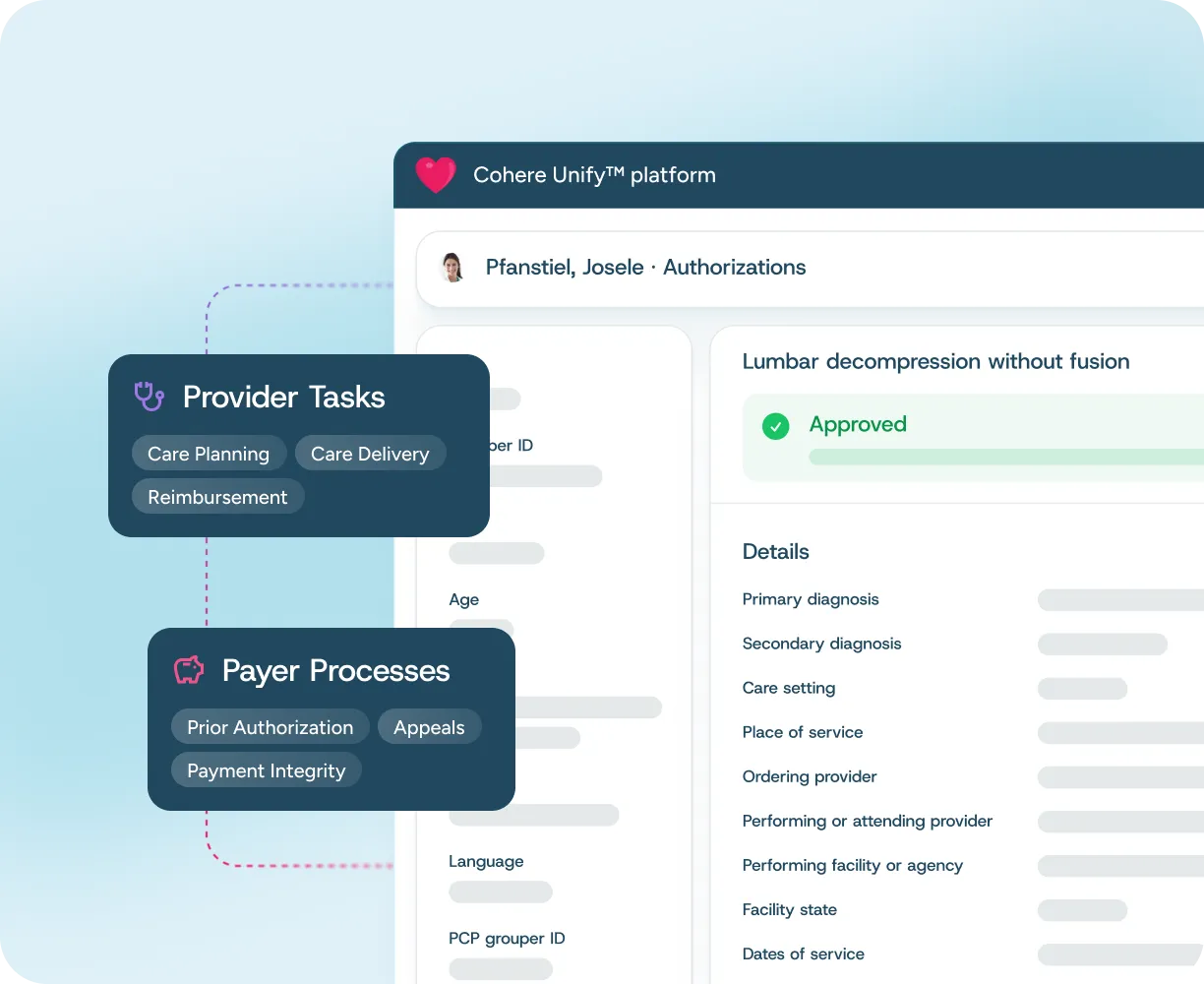
Cohere Unify is the clinical intelligence and operations platform powering healthcare workflows across the care continuum. Unlike siloed AI tools layered onto existing broken processes, Unify offers something different: a path to redesign how clinical operations work—breaking down functional silos, sharing intelligence across every handoff, and building a new operating model from a foundation already proven at scale.
Built on domain-specific AI systems trained on real-world clinical decisions, Cohere Unify combines precision clinical intelligence, workflow orchestration, and human oversight in one extensible platform. Because in healthcare operations, AI alone isn’t enough. Context, governance, and clinical precision matter.
**AI isn’t the strategy.** Operational coherence is.
Cohere Unify™ connects clinical intelligence across healthcare operations, so every decision makes the next one smarter rather than disappearing between functions.
Built for plans. Trusted by clinicians.

Stats
15M+
clinical decisions annually
99.4%
AI clinical accuracy
27M
unique patient profiles
Up to 50%
faster reviews
30–50%
operational cost reduction
4,500+
codified policies & guidelines
What makes Cohere Unify different?
This isn’t a startup experiment. This is connected, proven clinical intelligence across your operations.
- Connected intelligence across workflows
- Human-centered by design
- Flexible deployment with approved data residency
- Progressive autonomy and governance
- No rip-and-replace implementation
Inside the platform
Four interconnected layers, from foundation to execution
A system that gets smarter across functions, not just within them.

Agentic Harness

Agentic Skills Library

Clinical Context Layer

AI Data Platform

How Cohere Health helps health plans redesign their AI strategy
Point solutions automate tasks. Cohere connects operations.
- Built on clinical intelligenceNot a digitized workflow with AI bolted on.

Trained on real-world clinical decisionsPolicy-aware automationSuperior unstructured data handlingTransparent, auditable outputsHuman reviewer benchmarked - Connected by designOne platform, not another silo. Start where the need is greatest, expand as confidence grows.
Shared clinical contextIntelligence compounds over timeExpand without adding silosReusable workflows and capabilitiesEnterprise-wide operational visibility - Governed for healthcareBuilt to support the regulatory and operational standards health plans require.
HITRUST certifiedCMS-0057-F alignedDesigned to support HIPAA complianceHuman-in-the-loop oversightProgressive autonomy framework
“The results of Cohere Health’s digital authorization platform have exceeded our expectations.”
Built for healthcare's hardest operational challenges
Utilization Management
Payment and Claims
Quality and HEDIS
Appeals Management
Care Management
Responsible AI
AI that earns trust before expanding responsibility.
Assist first
Evaluation-driven approach
Humans in control
“Working with Cohere Health is transformational in Geisinger’s long history of clinical innovation…”
AI governance
Infrastructure your security and operations teams will approve
Data never leaves approved environments
Flexible deployment architecture
Enterprise-scale orchestration
Real-time workflow execution
Integrations
Works with the systems you already run
Native integrations with Epic, Rhyme, Availity, NaviNet, and CMS-0057-F APIs–plus flexible interoperability across existing systems of record and workflows.
Ready to operationalize connected clinical intelligence?
See how Cohere Unify helps health plans reduce administrative burden, improve clinical accuracy, and connect intelligence across every workflow.
Want to learn more about our solutions?
Browse the most common questions we are asked to help you make the most of your decision to modernize your clinical and healthcare operations…and beyond!
What exactly is Cohere Unify, and how is it different from your products?
Cohere Unify is the intelligent foundation that powers all our solutions. Rather than a standalone product, it's the highly-composable underlying platform that provides clinical AI capabilities, interoperability, and workflow intelligence across our entire solution portfolio. This platform approach means you can add capabilities without disruption as your needs evolve. With the expansion of Cohere Unify, this foundation now extends across appeals, care management, quality, and claims operations–giving health plans a single intelligence layer across the full clinical operations lifecycle.
How is Cohere Unify different from deploying multiple AI point solutions across our health plan?
Point solutions automate individual tasks. Cohere Unify connects them. The difference matters because clinical decisions across prior authorization, appeals, care management, claims, payment integrity, and quality are not independent–they are interdependent. When those functions run on separate AI tools, intelligence disappears at every handoff. A prior auth decision that should inform a downstream appeal doesn't. A care management flag that should reach claims never does. Each tool starts from scratch, and health plans pay the price in fragmented outcomes and compounding administrative burden.
Cohere Unify is architected around those connections. Every agent draws from the same clinical context layer, the same specialized skills library, and the same precision AI foundation–so what one function learns, every function benefits from. You don't get five AI tools that don't talk to each other. You get one intelligence layer that gets smarter across your entire operation over time.
Some AI vendors promise ROI on day one or implementation in weeks. How does Cohere approach implementation?
We've seen what happens when AI is deployed faster than it can be trusted: failed pilots, low adoption, and clinical teams who are more skeptical of AI than when they started. Implementation speed is ultimately constrained by health plan readiness, not vendor promises. A vendor who claims ROI on day one is making a claim about your organization that they have no basis to make.
Cohere Health's approach is different. Every capability we bring to market has been benchmarked against human reviewers and validated through our evaluation-driven development process before it reaches production. Our assistive solutions deploy in weeks, not months, because they work alongside your existing systems rather than replacing them. But we lead with quality, accuracy, and dependability, not speed claims we can't own on your behalf. The result is adoption that sticks, outcomes that hold up to scrutiny, and a platform that expands as your confidence grows rather than stalling in pilot purgatory.
Will deploying Cohere Unify reduce clinical headcount or replace our reviewers?
No, Cohere Unify is designed to help your clinical teams work at the top of their license, not to replace them.
The problem we're solving is not that health plans have too many clinical reviewers. It's that those reviewers spend too much of their time on work that shouldn't require their expertise: excavating records, orienting to cases, searching for documentation that may or may not be there. A skilled appeals nurse spending 45 minutes on case prep before making a single clinical judgment is not a staffing problem. It's an intelligence problem. Cohere Health solves it by doing the heavy lifting: reading records, organizing evidence, surfacing the right information at the right moment, so your team can focus on the decisions only a human should make.
Clinical judgment stays with your people. AI earns expanded responsibility only as it is validated, and complex clinical determinations always retain a human in the loop.
How is Cohere Unify different from other AI solutions on the market?
Unlike AI point solutions tools that focus primarily on digitizing manual processes, Cohere Unify was built from the ground up as a clinical precision AI platform that embeds responsible intelligence directly into clinical workflows.
Do we need to replace our current systems of record to use Cohere Unify?
No. Cohere Unify is designed to complement and enhance your existing systems. We can start with specific high-impact areas (like specialty-specific authorizations) while maintaining your current processes elsewhere, allowing for gradual transformation rather than disruptive replacement.
How does the clinical AI actually work within clinical decision and authorization workflows?
Cohere's clinical AI functions as an intelligence layer across clinical operations–not a standalone tool layered onto existing processes, but a connected system that shares context across every workflow it touches.
For providers, this means guidance embedded directly in clinical workflows: surfacing missing documentation before an authorization is submitted, reducing back-and-forth, and enabling real-time approvals for up to 85% of routine requests based on evidence-based guidelines. The result is less administrative friction at the point of care.
For health plan clinical teams, the intelligence goes deeper. When manual review is required, Cohere Health agents read and reason over unstructured clinical documentation–identifying, extracting, and citing the indication data that maps to medical policy, so reviewers spend their time on informed decision-making rather than fact-finding. The same clinical intelligence that powers prior authorization doesn't stop at the authorization decision. It carries forward–informing appeals reviews, surfacing care management opportunities, identifying appropriate care settings, and feeding quality gap closure, so every function benefits from what the previous one already learned.
This is what separates Cohere from point solutions that automate individual tasks: clinical intelligence that compounds across the enterprise rather than starting over at every handoff.
What makes your precision AI "clinical grade" compared to other AI solutions?
Our clinical AI is built on a foundation of evidence-based clinical guidelines and trained on millions of real authorization decisions. >450 Clinician-trained, fine-tuned models consistently outperform state-of-the-art LLMs. Our precision AI can assist clinical reviewers using AI/ML to enhance review quality for complex cases. Unlike general-purpose AI, our highly trained LLMs pull unstructured data from clinical attachments using a minimum necessary approach to optimize responsible AI. The result is decision support that both providers and health plans can trust. Our models are specifically trained to read, reason over, and cite indication data within unstructured clinical documentation–the category where generic AI fails most often and where the highest-value clinical insights are most frequently buried.
How does Cohere Unify help us address interoperability and prior authorization regulations?
The Cohere Unify platform leverages CRD, DTR, and PAS APIs that fully align with HL7® Da Vinci™ Project implementation guides. The platform also supports “single front door” integrations whereby the provider can submit authorizations through Cohere APIs regardless of which entity performs the clinical review. In addition, Cohere’s approach to medical policy digitization supports greater provider burden reduction in the DTR workflow by eliminating the need to surface clinical assessment questions to the reviewer, instead pulling unstructured indication data directly from clinical documentation. This full support for CMS-0057-F is also available to customers via Cohere Connect™, a standalone solution powered by the Unify platform.
Does Cohere have established practices for handling and encrypting Protected Health Information (PHI)?
Yes, Cohere adheres to regulations under both the Health Insurance Portability and Accountability Act (HIPAA) and HiTECH. All Protected Health Information (PHI) received by Cohere Health is protected by administrative, physical, and technical safeguards. All sensitive information we collect is protected by encryption software, both in transit and at rest via AES-256 bit keys and TLS 1.2+, respectively.
Is Cohere compliant with HIPAA requirements?
Yes, Cohere is certified by HITRUST, NCQA, and URAC. Cohere has a Compliance Program based on the OIG Seven Elements of Compliance. This plan has been reviewed and approved by both NCQA and URAC.
What does precision AI mean in the context of payment integrity?
Much like in UM, Cohere Validate and Cohere Complete for PI leverage precision AI, specifically trained on clinical data and reimbursement methodologies, to ensure the highest accuracy in coding and clinical validation.
What measures are in place to ensure platform security in operation and ongoing development
The Unify platform uses AWS and many of its core services, including the latest cloud and database technology. The portal is available through TLS 1.2+ Cloudfront content distribution and includes a Web Application Firewall (WAF) attached to analyze and monitor all incoming traffic. Multiple AWS VPCs are leveraged to ensure the isolation of environments and overall security. Elastic Load Balancers then direct traffic onward. Fargate and ECS are all used to facilitate the development process in a secure and repeatable manner.