**AI-powered appeals** so your review nurses can close more and dig less
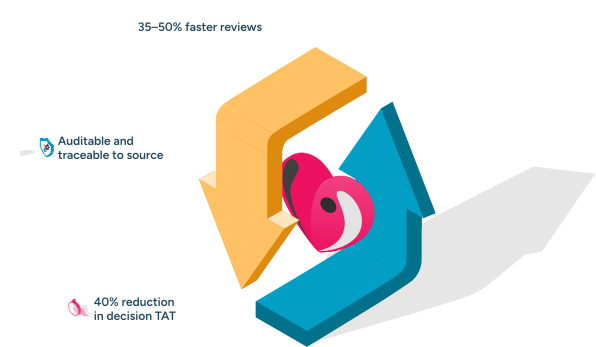
Cohere Appeals Assist™ prepares every clinical appeal before your reviewer opens the case; surfacing evidence, evaluating guidelines, and drafting documentation so your team can focus on the determination, not the search, resulting in 50% faster reviews and up to 40% reduction in decision TAT.
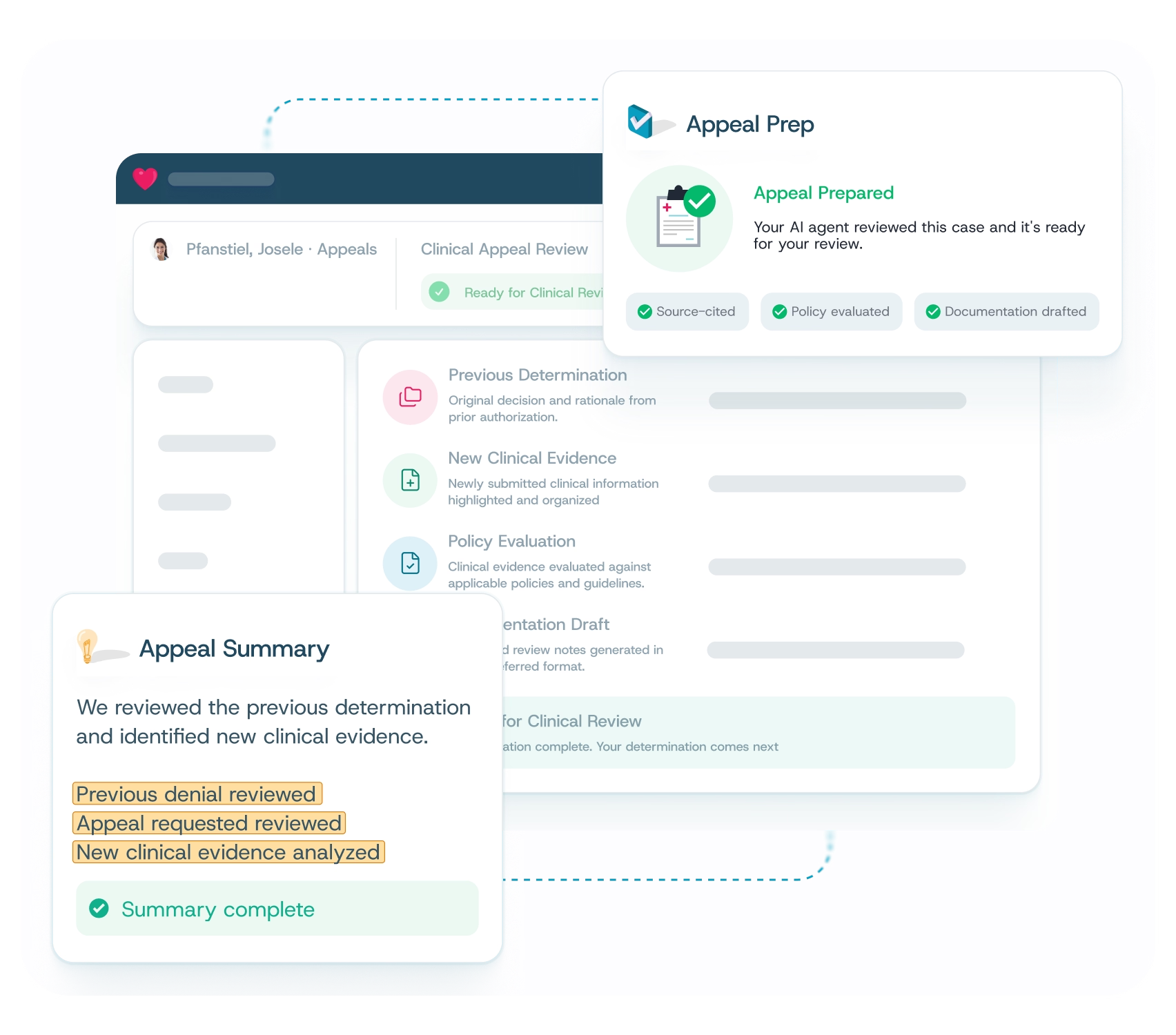
Close appeals cases faster, maintain compliance, and improve documentation consistency–all without adding reviewer burden.
Without Cohere
- Reconstruct prior case history
- Search through hundreds of pages
- Cross-reference guidelines manually
- Draft review notes from scratch
- Manual comparison of prior and new evidence
- Compliance impacted during appeal volume spikes
With Cohere Appeals Assist
- Case history pre-summarized
- Relevant evidence surfaced in structured format
- Guidelines evaluated automatically
- Notes pre-drafted in standard format
- Evidence differences highlighted for reviewer
- Streamlined workflow to maintain compliance despite volume spikes
Faster case closure.
Every case arrives organized, summarized, clinically evaluated, and with newly submitted data highlighted before reviews begin, reducing preparation time by up to 50% and decision TAT by up to 40%.
Audit-ready quality.
Greater than 99% AI clinical accuracy helps improve review consistency while maintaining full traceability to source records, policies, and evidence-based guidelines.

Smarter with every case.
Appeals outcomes feed connected workflows upstream–surfacing denial patterns, documentation gaps, and policy insights that continuously improve enterprise-wide performance.
Tailored to your needs.
Clinical AI evaluation aligns to your health plan’s policies, compliance requirements, and reviewer escalation workflows–not a generic ruleset that treats every health plan the same and delivers outcomes that reflect it.
Clinical judgment protected, everything before handled
Cohere’s appeals agents automate the preparation work across the appeals lifecycle, so every case arrives organized, evaluated, and ready for human review.
1. Intake AI-assisted
Fax, portal, mail, and attachments are ingested, digitized, classified, and routed without heavy manual intake work.
2. Cases summarized
Prior reviews, patient history, and new clinical evidence organized into a reviewer-ready case summary with new information clearly identified for faster decisioning.
3. Evidence evaluated
Clinical evidence evaluated against applicable policies and guidelines, with findings cited inline and linked directly to source records for audit-ready determinations.
4. Review notes drafted
Structured review notes generated in your preferred format, supporting documentation consistency, MD escalation and audit preparation, and faster case finalization.
5. Questions answered instantly
Casey, Cohere's clinical chatbot, surfaces answers from guidelines and clinical member records on demand so reviewers never lose time searching mid-review.
Estimated Impact
Cohere in action
Real results for health plans and their teams.
up to 50%
faster AI-assisted reviews
10%
fewer unnecessary complex case reviews
1+ days
faster TAT on standard reviews
Why generic AI fails in appeals
Clinical appeals require policy-aware intelligence, not generic AI summarization.
Most AI tools can summarize text. Very few can reason over clinical evidence,
align findings to medical policy, and produce outputs that hold up under audit and appeal scrutiny.
Generic AI
- Hallucinates unsupported conclusions
- Lacks policy awareness
- Misses buried indication data
- Cannot trace outputs to evidence
- Not benchmarked against reviewers
- Lacks connectivity to UM documentation
Cohere Appeals Assist
- Policy-aware clinical reasoning
- Source-cited outputs
- Trained on real health plan decisions
- Human reviewer benchmarked
- Fully auditable and governed
- Leverages connected intelligence for evaluation
Connectivity
Built for real health plan operations, not generic AI demos.
Cohere Appeals Assist is purpose-built for interoperable workflows, real-world adoption, progressive autonomy, health plan configurations, and clinical governance, not experimental and generic AI your teams will reject.
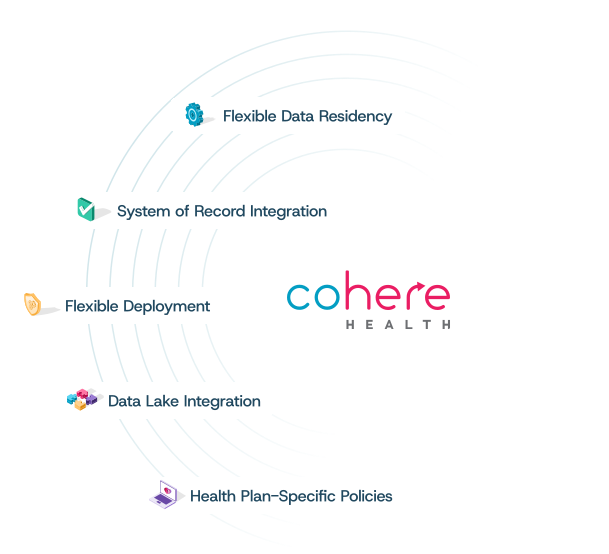
Designed for adoption, not disruption.
Works with existing systems of record
Human reviewers remain in control
Progressive rollout and governance
How much faster could your team **close cases** if the preparation work was already done?
See how Cohere Appeals Assist agents prepare every case before your reviewer arrives, so your people spend their time on the work only a human can do.
Your questions, answered
Find answers to frequently asked questions about Cohere Appeals Assist and learn what it actually looks like to run a more efficient and higher-quality appeals operation.
How is Cohere appeals agents different from general-purpose AI tools?
General-purpose AI tools can summarize text, but clinical appeals require much more than summarization. Appeals reviewers need policy-aware reasoning, traceable evidence evaluation, new evidence summarization, audit-ready outputs, and workflows aligned to health plan operations, documentation standards, and turnaround-time requirements. Cohere appeals agents are built specifically for that environment and trained on real health plan decisions, benchmarked against clinical reviewers, and governed through evaluation-driven development before deployment. Additionally, Cohere runs analytics on the outcomes of appeals, supercharging value across our connected solutions such as utilization management.
What types of appeals does Cohere Appeals Assist support?
Cohere appeals management is built for clinical appeals–cases where medical necessity, level of care, or clinical documentation is at the center of the determination (e.g. Procedure Medical Necessity, Level of Care and LOS Medical Necessity, Dx Clinical Validation, etc.) It is not designed for purely administrative appeals. If you're not sure whether your appeal mix is a fit, we'll tell you directly in a discovery conversation.
Does the AI make the final call on appeals?
No, and that's by design, not limitation. Cohere appeals agents prepare, summarize, evaluate, and draft as outlined above. The clinical determination always belongs to your reviewer. As quality benchmarks are met and confidence grows, the platform is built to take on more, but complex clinical decisions will always have a human in the loop.
How does Cohere handle unstructured clinical records?
This is where most AI solutions quietly fail and where Cohere has deep investments. Reading, reasoning over, and citing indication data buried in physician notes, discharge summaries, and operative reports requires models trained on real health plan decisions, not general clinical text. Ours are. The result is clinical evidence that surfaces accurately, cites completely, and holds up when it's challenged.
How do we know we can trust what the AI produces?
Every capability goes through our evaluation-driven development process, benchmarked against human reviewers before it ever reaches production. We target greater than 99% AI clinical accuracy and don't release what hasn't earned it. In production, every AI action is logged and traceable to its source, so your reviewers, auditors, and compliance teams can verify every step. Trust isn't a feature here. It's the foundation.
What data do the agents use, and where does it go?
Cohere appeals agents draw from authorizations, claims, appeals records, clinical attachments, guidelines, and plan-specific work instructions. Data governance, HIPAA compliance, and PHI handling follow the same standards as Cohere's UM suite–HITRUST-certified, data never leaves your approved environment, and deployment is flexible based on your residency requirements.