Helping care managers spend time **guiding care**, not processing paperwork
Cohere Care Assist™ identifies the right members, surfaces every care gap, and drafts the care plan, so your team spends their time on ensuring members are on the optimal care path, not the administrative work that surrounds them.
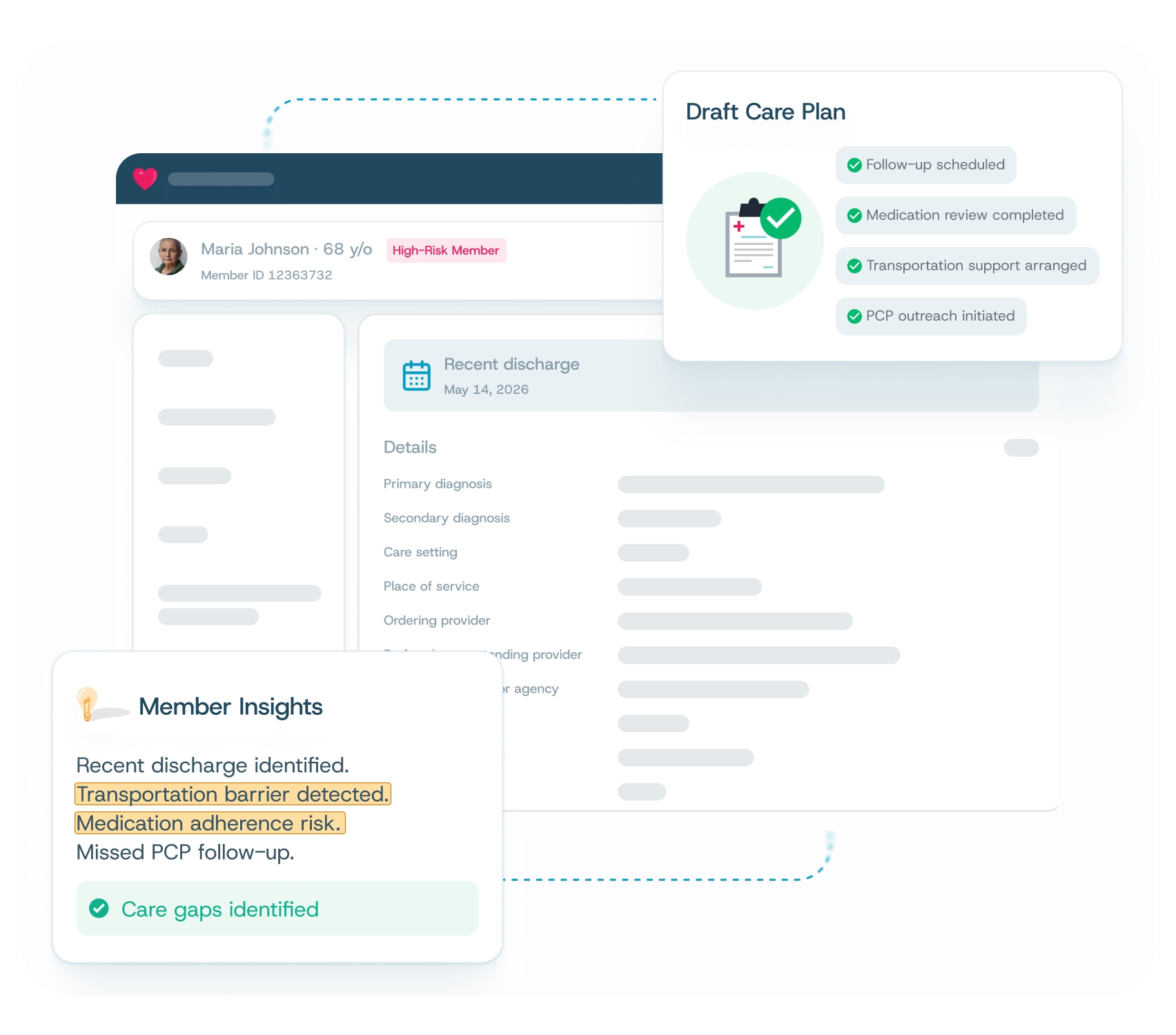
From the right member to the right care plan–before your team picks up the phone.
Without Cohere
- Rising-risk members buried in outdated/lengthy clinical records
- Reconstruct fragmented clinical history across disconnected systems
- Check discharge plans against TOC checklists and identify medication or SDOH gaps by hand
- Build care plans from scratch against plan templates
With Cohere Care Assist
- High-risk members identified based on your criteria + patient profile
- Patient 360 summarized in a clinically relevant and structured format
- Discharge plan gaps surfaced against TOC checklist automatically
- Individualized care plans drafted from clinical evidence and plan guidelines
Smarter member prioritization
Identify high-risk members to ensure no patient at risk is missed and transitions stay on track.
More time with members
Care managers spend less time navigating systems and assembling documentation, and more time supporting members directly.
Scale without added headcount
Automation prepares summaries, evaluations, and care plans before outreach begins, helping teams manage growing caseloads efficiently.
Quality & consistency across every transition
Every case is evaluated against the same plan requirements, workflows, and evidence standards to reduce variation across teams.
From identification to intervention, automated
Cohere Care Assist™ identifies eligible members, summarizes patient information, evaluates discharge readiness, and prepares care plans before outreach begins.
1. Members prioritized
Highest-risk members undergoing time-sensitive transitions of care are automatically identified and ranked by risk, so the most vulnerable patients are never missed.
2. History summarized
Diagnoses, medications, prior admits, and functional status are assembled into a structured clinical brief with risk factors highlighted.
3. Care gaps surfaced
Care gaps are automatically surfaced and closable within the workflow so care managers never miss a measure that matters for member health.
4. Care plans drafted
Individualized and compliant care plans generated by case type, with member goals, follow-up schedule, medication adherence support, SDOH referrals, and assistance program eligibility already populated within approved health plan template.
5. Questions answered instantly
Casey, Cohere's clinical chatbot, surfaces answers from guidelines and member records on demand, so care managers never lose time searching for what they need.
Estimated Impact
Cohere in action
Real results for health plans and their teams.
up to 50%
faster AI-assisted reviews
10%
fewer unnecessary complex case reviews
1+ days
faster TAT on standard reviews
Why generic AI falls short in care management
Care management requires clinical intelligence.
Most AI tools can summarize a patient record. Very few can identify which members need intervention, catch discharge plan gaps before they become readmissions, and produce care plans that hold up to clinical and regulatory review.
Generic AI
- Summarizes documents without clinical context
- Cannot identify members against plan-specific TOC criteria
- Misses SDOH signals buried in unstructured records
- Outputs untraceable to clinical evidence
- Not benchmarked against care management workflows
Cohere Care Assist
- Clinically trained member identification and triage
- TOC-specific gap detection against discharge checklists
- SDOH and risk flag surfacing from unstructured records
- Every output cited to source documentation
- Human care manager benchmarked, evaluation-driven
Connectivity
Built for how care management actually works.
Care management programs run on a patchwork of systems, manual processes, and institutional knowledge. Cohere's agents are designed to work within that reality.
Cohere Care Assist operates on the same connected intelligence layer powering Cohere Unify™ across utilization management, appeals, quality, and payment integrity workflows.
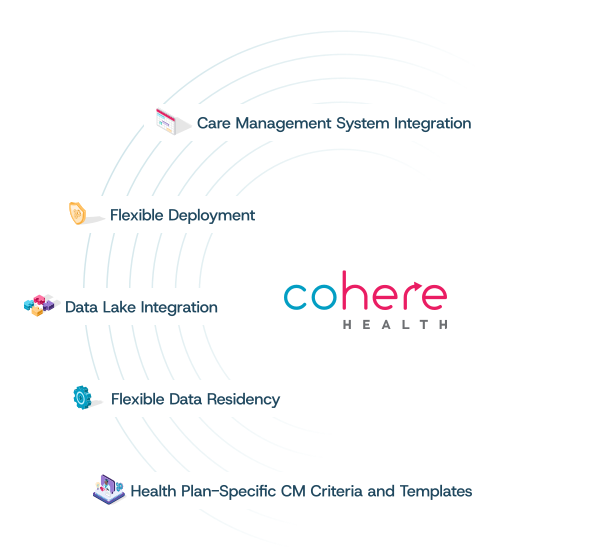
Built for care managers, not around them.
Seamlessly integrates with existing workflows
Progressive rollout and governance
Human care managers remain in control
What could your care managers **accomplish** if paperwork wasn’t in the way?
See how Care Assist surfaces the right members, prepares every case, surfaces care gaps, and drafts every care plan before your team picks up the phone, so your people spend their time on the tasks only a human can handle.
Your questions, answered
Find answers to frequently asked questions about Cohere Care Assist, and learn what it actually looks like to run a more effective, less burdensome transitions of care program.
How is Cohere Care Assist different from general-purpose AI tools?
General-purpose AI tools can summarize a patient record. Care management requires much more: clinical member identification against plan-specific TOC criteria, discharge plan gap detection, SDOH signal extraction from unstructured records, and care plan generation that holds up to clinical and regulatory review. Cohere's care management agents are built for that environment: trained on real health plan decisions, benchmarked against expert care managers, and validated through evaluation-driven development before deployment.
What types of care management programs does Cohere support?
Cohere Care Management is built for transitions of care, discharges, and high-frequency admissions programs–where high-risk member identification, discharge plan gap assessment, and care plan generation are the primary operational challenges. We'll tell you directly in a discovery conversation whether your program mix is a fit. We'd rather have that conversation early than overstate what we do.
Does the AI make clinical decisions about members?
No. Cohere's care management agents identify, summarize, flag, and draft. Clinical judgment about a member's care needs, gap prioritization, and care plan direction always belongs to your care manager. As quality benchmarks are met and confidence builds, the platform is designed to expand, but member-level clinical decisions will always have a human in the loop.
How does Cohere handle unstructured clinical records?
This is where most AI solutions quietly fail and where Cohere has deep investments. Reading, reasoning over, and surfacing SDOH signals, discharge risk factors, and care gaps buried in physician notes, discharge summaries, and operative reports requires models trained on real health plan decisions like Cohere’s are, not general clinical text. The result is a member summary that reflects what's actually in the record, not just what was easy to extract.
How does this connect to our UM and quality operations?
For plans already on the Cohere UM platform, the connection is built in, and it works in both directions. UM data proactively flags members and provides richer context for care managers, enabling earlier and more informed outreach. In turn, care management activity helps proactively close quality and HEDIS gaps, driving better outcomes across the enterprise. Care Management is also available as a standalone solution, with the full connected intelligence value available as you expand.
What data do the agents use, and where does it go?
Cohere's care management agents draw from member eligibility, authorization data, clinical records, care management eligibility criteria, plan’s evidence-based care guidelines, and plan-provided care plan templates. Data governance, HIPAA compliance, and PHI handling follow the same standards as Cohere's UM suite; HITRUST-certified, data never leaves your approved environment, and deployment options are flexible based on your residency requirements.